Grandpa’s Feet

Part 1, May

The Mansion

His face wizened and his body shrunken from its former robustness, Sam Oliver sat in his battery-powered wheelchair at the top of the staircase above the foyer of his mansion.

Grampa always looked old to me, even if he was only fifty-three, just over half my age when he died. He had nothing, yet he had what I don’t have—a loving child, Auntie Angie, beautiful Angelina. What a portrait Botticelli could have made of her, my angel auntie.

He allowed the ancient memory to coalesce into a vivid scene, so easily realized now. There she was, kneeling at Grampa’s gnarled feet, the feet of a waiter who worked 12 hours a day, six days a week to feed his motherless family. There was the bowl of steaming water laced with Epsom salt, waiting on the floor near his bare feet. His faded pajama pants were rolled over his knobby knees, exposing long but sparse hair on his ropy legs.

Sam remembered hiding on the floor of the portable wardrobe in the bedroom Grampa and Uncle Pete shared. It smelled of moth balls and old leather, not like the sweet, powdery smells where he, his mother and Auntie Angie slept. A seven-year-old could hide here forever without being noticed.

Angie was a nurse in training. She intended to join the Army Nurse Corps. She wanted to be a good nurse, and Grampa was her most important patient until she would receive her Army assignment. Maybe she would meet daddy there, in the war.

She learned to scrape and shave bunions and calluses, and to trim ingrown toenails—all of which Grampa’s feet had. He was sitting on the bench at the foot of the bed, his chest wrapped in a brown flannel bathrobe. His feet rested on the large towel on either side of the bowl of steaming water.

Auntie Angie was still in her nurse’s whites, but had taken off the bird-like cap and had laid it next to the smelly ashtray on the table next to the wardrobe. She lifted one of Grampa’s feet and let it slide gently into the bowl of water as she talked to him. He was too tired to talk, except for a few grunts of response. She told him of the young student nurses and doctors she worked with, stories of their backgrounds—where they came from and where they wanted to go after completing their education. He listened with his eyes closed, the corners of his mouth relaxing upward. The big alarm clock on the nearby table ticked off the seconds and minutes.

After Grampa’s foot soaked long enough, Angie gently removed it from the basin and placed it on the towel. Then she placed his other foot in the basin.

The foot on the towel was mostly hard and yellow, even if part of it was pink and soft-looking from the warm water.

Grampa’s toes and toenails fascinated him. They were ugly and clumpy, some of them twisted. It was the big toe on the exposed foot that was the most repulsive. It was swollen and purple from infection caused by the nail invading the underlying flesh.

But then Auntie Angie made Grampa’s toes beautiful. With her nurse’s tools she cleaned out the accumulated dead skin under each toenail and cut the clumpy, yellow nails. She carefully pried one of her tools under the nail that bit into Grampa’s big toe and, little by little, carved the nail away until the compressed flesh released its yellow pus and small bit of bright red blood. Only then did Grampa come alive with great sigh of pleasure, showing how painful it must have been. 

Angie then attended Grampa’s other foot. When she was done he leaned toward Angie, took her head in his cigarette-stained fingers, kissed her forehead and said, simply, “Angelina,” in his melodious Mediterranean accent, made rough by tobacco smoke. 

Then the image changed. Sam had now taken Grampa’s place and there was an angelic face near his knees, looking at him with love and saying pleasant things.

The reverie vanished as his nose twitched to the acrid odor of burnt cheese rising from the endless procession of frozen pizzas into and out of the large microwave oven in the kitchen at the far end of the building. It wasn’t as bad, at least, as the awful smell of overheated butter and popcorn that had earlier invaded his room.

The children have finally outlasted the weak discipline of the adults. He pondered whether he was chuckling or grumbling, but couldn’t decide.

He had lost track of the numbers of grandchildren, grand-nieces and –nephews, and now the following generation. He could evict them and their parents, of course, but despite all their carelessness and thoughtlessness and selfishness, he couldn’t bring himself to deny them the unearned benefits of being his relatives.

“Perhaps there’s one among them,” he said aloud, a phrase he had, until recently, only given thought to, countless times.

He was grateful he could not hear the racket below, which he could easily imagine. He rarely turned on his hearing aids. 

He wheeled his chair around, past the elevator, to return to his room. He was expecting Diana, his “chief of staff,” as he thought of her, and wanted to be prepared.

He lived in an apartment that extended across half the second floor of the three-story building. It had the amenities and services necessary for a couple with two children to live in comfortably. This was what it was originally designed for—a place where one of his children or, after his two sisters died, one of his nephews or nieces and their families could live. There were other such apartments in the mansion and in the attached addition where the servants and the single relatives lived.

Five of these apartments were occupied. The oldest offspring had fled the internecine warfare that physical closeness invited, having finally garnered all they could of his fortune, short of what they were to be bequeathed upon his death—and when, by God, was he ever going to die? He knew they said this, or something like it.

“I won’t give them the satisfaction,” he said under his breath.

     Diana wasn’t due for an hour. His preparations were merely to pass a damp cloth over his face and comb his sparse hair, having been fully bathed and dressed by his masseur before Sam went to the staircase over the foyer.

He moved his chair to the window in the living room to wait for Diana. He leaned forward to view the broad sweep of the estate—green lawns, flower and vegetable gardens, and coppices of native trees and bushes. Here is where man and nature have made a truce, a noble tension to be broken only when I finally stop breathing and others will oversee the property.

Techniques of medical science had kept his eyes clear, especially for seeing in the distance. This view was his greatest pleasure, now that his business and political victories were decades behind him.

“There are no victories in a family,” he muttered, not knowing what he really meant. He slumped back into his wheeled chair, lapsing into thoughtfulness as the hissing tinnitus in his ears provided familiar background.

The notion of “family” had confused him, always. It was like a great beast without boundaries. It had no constant shape; there was no way to control it. It threatened always to swallow you or run away from you. And, there was no one who would bathe an old man’s feet.

A sudden, unfocused view of the lower part of Diana´s dark blue business suit brought his head up. She was saying something, but he couldn’t understand. As he focused on her face she pointed to her ears, and he automatically reached behind his own to turn on his hearing aids.

“—something wrong with your feet?”

“Uh, no Diana, I was just muttering I guess.”

“Are you ready for the weekly report?”    

“Yes, yes, let’s go. Please sit down. You make me nervous standing there. Bring the chair closer—I don’t want to shout. You look wonderful, as usual, even though you are wearing pants with that suit. Don’t women wear skirts any more?”

“Most professional women wear slacks, now, Mr. Oliver. It tends to keep the men’s minds more on business…”

“… than funny business, you mean. It’s a good point, especially since there are so many women now where men used to be.”

“Do you want me to buzz Henry for something?”

“Ah, yes, some water with lime. Thank you. And tell him to get the kids out of the kitchen and clean up the mess. It must be a swamp down there. The smell has been with me all morning.”

Diana reached for a nearby walkie-talkie, one of many available everywhere in the old man’s apartment.

“Henry, it’s Miss Davies. I’m with Mr. Oliver. He would like some water with fresh lime, and a cup of black coffee for me, please. Mr. Oliver would like you to tell the children to leave the kitchen. Have them take all food outside on the patio and then ask Maude to clean the kitchen and put it off-limits for the rest of the day. Yes. Thank you.”

“Good.  Henry’s a better disciplinarian than I am. Their parents have given them no boundaries. Anything new from your end?”

“The new things are more of the old things. Franklin is getting further into debt and is getting panicky. Elizabeth has filed for divorce from Jerry…”

“I forget what number husband Jerry is.”

“… number three. And Theodore has started seeing a psychiatrist for his anxiety and depression. His AA group insisted on it.”

“Well, they’re all going have to stew in their own juices. I’m not rescuing any of them any more. Their trust fund income is enough to keep them from starving and sleeping under bridges. They can liquidate some of their assets. It’s enough for me to support their progeny, endlessly. How many are living in the house now?”

“Let me see… 18, if you don’t count the sleepovers. Most of the children are from your sisters, may they rest in peace—as they probably are doing, thanks to you. Henry seems to have the supply issues under control, but Maude is getting frazzled with all the cleanup.”

“Get her a part-time helper.”

“Part-time will mean low quality, I’m afraid. You need another live-in maid, a younger one that Maude can reasonably expect to boss and who won’t require too large a salary. I think we can find a young person from Europe who would like to do her wanderjahr or two in the USA, someone who could attend to your needs, as well. You’re not looking as natty as you like to be. Your masseur doesn’t have all the talents you need.”

“Hmph. As Captain Picard says, ‘make it so.’ Are you getting paid enough?”

“Mr. Oliver, you shouldn’t ask that of a lawyer. Your contract with the firm makes generous provision for my services.”

“I’ll take that as a yes. Other than Maude and Henry, you’re the only one who is kind to me, but of course I am paying you all. Please don’t respond to that. I’m getting crankier all the time.”

“Do you want Dr. Benjamin to visit you? More often, I mean? You mentioned your feet earlier. Are they bothering you?”

“No, No. I’m all right. And I get out of my chair often enough to get properly exercised—the therapist sees to that. He’s very tough and mean, but he’s good.”

“Is the catering service on time and satisfactory?”

“Yes, yes, but of course the nutritionist won’t give me what I want. She intends to keep me alive as long as possible. Her greed knows no bounds. Come closer. You smell especially good today, Diana.”

“Don’t get fresh, Mr. Oliver, your heart might go into tachycardia again.”

“Denied everything for my own good, right?”

“It’s the way you want it, isn’t it? To keep your progeny in a state of anxious anticipation?

“You know me too well, Diana. I feel naked in front of you, and that’s not an ironic invitation to anything.”

“Here’s Henry, now.”

“Good afternoon Miss Davies.”

“Hello, Henry. How did the children take it?”

“Surprisingly well, ma’am. They seem to know what’s right—they just have to be reminded.”

“Henry, I’m thinking of getting someone to help Maude. How about you? Do you need help with the chaos of the growing horde?”

“No, sir. The regular maintenance service keeps all the major appliances and household machinery in top shape, and the handyman and landscape services handle all the other tasks, so I have a reasonable number of duties to perform.”

“You’re too damned reasonable, Henry. You’re not getting younger, either. Are you getting enough sleep? Are you taking days off?”

“Please don’t worry, sir. I am quite comfortable and you provide for me generously.”

“Hmph.”

“Will that be all, sir?”

“Yes, yes, Henry. Back to the salt mines.”

“Thank you, sir.”

“Thank you for the coffee, Henry—it’s excellent, as usual. I’ll drop by to see Maude before I go, Henry. See you later.”

“Bye, ma’am.”

     “Now, how about you, Mr. Oliver?”

“Enough about me Diana, just get that girl from Europe so Maude can grow older a little more gracefully.”

“Do you want to interview the candidates?”

“No, no, I trust you Diana. I know, I know, a lawyer takes nothing for granted—no assumptions. You want it in writing? Don’t answer that. Do you have to go now?”

“I’m afraid I have a full calendar for the rest of the day.”

“Are you going to get married one of these days? I think you should, but I don’t want to lose you. What’s wrong with men these days? You’re a beautiful woman… oh, I’m sorry for going on, and I won’t mention children, either, and how a woman hasn’t got as much time as a man…”

“Dear, dear Mr. Oliver. It’s very hard to be completely professional with you. It isn’t a question of finding a good man; it’s a question of how to balance all the good things life has to offer. Having nice clients like you is part of the equation. Now that’s enough, but thanks for your concern and your compliments.   

“OK, off to the gold mines with you.”

“I’ll have someone in place for Maude, and you, within two months. I’ll offer enough income and time off to make the opportunity compelling.”

“OK, Diana. Next week, then.”

“Goodbye, Mr. Oliver.”

Part 2

July, Two Months Later
Sam Oliver’s Sitting Room

“Mr. Oliver, this is Linn Larsson. She’s from Uppsala, Sweden.”

“Hello, I’m glad you’re here. How’s your English?”

“Thank you Mr. Oliver. I learned English in school, since I was a little girl.”

“Well, I can understand you very well, and that’s what’s important. You just let Diana, Miss Davies know what you need and she’ll get it for you”

“Thank you.”

“Okay, now you know that Maude is your boss, yes?”

“Yes, Mr. Oliver, and I am to help you with any of your needs, too. I used to help my grannies.”

“Well, Linda…”

“Linn, it’s Linn…”

“A pretty name, Linn. I’ll remember it. Anyway, Miss Davies here seems to think I need to be spiffed up.”

“Spiffed?”

“Linn, Mr. Oliver likes to be well dressed and well groomed, which means being neat in his hair and fingernails and so forth. His masseur, the man who gives him massages and takes care of some personal needs is, well, best at massaging.”

“Okay, I understand. I will be happy to spiff you Mr. Oliver.”

“Ha! That’s the first happy thing I’ve heard in a while. Yes, spiff me! Ha! Well, we’ll talk about that later. I’m glad you’re here, I think I said that already, and I’m sure Maude will be glad too. She’s not getting any younger and the kids are getting more rambunctious. You know about children as well as older people?”

“Oh, yes. I have younger siblings and I have worked as a helper in a day care school.”

“Well, Diana Davies, you’ve done it again. Linn seems like a good person to have in the house. I’d like to be alone with Diana now, Linn, and please ask Maude to make me a small snack.”

“If it’s okay, Mr. Oliver, I can do this for you. I’ll ask Maude what you like.”

“You’re on the ball already. Good.”

“On the ball?”

“He means you already know what to do, Linn.”

“Okay, I’ll get the snack.”

Linn left the room quickly to accomplish her first task.

“Young Linn is a remarkable girl, Diana. How can she have had so much experience and be so good in English?”

“We had some luck. After her year here, she intends to study for a medical degree and she wants to improve her English. As you can tell, she has had her career in mind for some time—that’s why she has sought out so much experience in helping people.”

“Well, she’ll spoil us for any future helpers, but one year at a time. Now, what’s to report, Diana? I have nothing new to say.”

“Mr. Oliver, I recommend you consider accepting a visit from Theodore. According to what he told me yesterday, his psychiatrist says it’s important for him to say certain things to you. If you agree, it could be difficult for both of you, certainly for Theodore, but apparently there’s something he needs to say.”

“Well, I can’t think of how I could become more disturbed by Theodore than I have already been. You said you ‘recommend I consider.’ That’s kind of weasel-wordy, counselor. You don’t sound like you think I absolutely should do it.”

“Full disclosure as your attorney, and as a friend, requires me to say it might well disturb you.”

“Needs to stand up to the old man, does he? Might be a good thing for him, and I don’t see how it could harm me. I’ve been chest-to-chest with some pretty tough gangsters posing as capitalists. It might be refreshing.”   

“I’ll ask again, tomorrow, after you’ve had a chance to think it over.”

“I don’t need to think it over—I’ll do it. But you can call me tomorrow to verify it.”

“May I come in, Mr. Oliver?”

“Is that Linn already? Yes, come in and put the snack on the desk at the window. I like to look at the scenery when I eat. And did a little animal follow you in the room? What kind of an animal looks like a child?”

“Megan wants to follow me. I hope it’s all right.”

“Who is Megan, Diana?”

“She is your sister Lucille’s great-granddaughter. She’s seven years old. Her grandmother is your niece Evelyn Pierce, and her mother is Janet Pierce-Moran. Janet lives on the third floor with her husband James Moran. He’s employed in one of your companies.”

“How come she isn’t frightened of me like all the others?”

“Perhaps she would answer that question herself, Mr. Oliver.”

“Linn, please bring Megan with you and stand close to me so I can hear her little voice better. Yes, that’s good. Thank you.

“Megan, do you understand what I am saying?”

“Yes, Grander.”

“Grander? Is that what I am called by the children?”

“Yes, Grander.”

“What do you think ‘grander’ means?”

“You’re the oldest grand.”

“Grand?”

“You know—older than all the grandmas and grandpas.”

“Well, that’s true enough, Megan. Are you Linn’s assistant, her helper?”

“Maybe. I like Linn.”

“Well, well—you’re welcome to be here when Linn helps me, if it’s all right with her and if you don’t run around and make a lot of noise.”

“I won’t, I promise, Grander.”

“I’m getting tired now. Let me eat my snack, everyone.”

“Goodbye, Mr. Oliver. Let’s go now, girls.”

So Theodore needs to talk with me, or to me. How long has it been since we had a real talk, father to son, man to man? Years, many years. He was such a good boy when he was a child. Life is so hard on weak people.

And Linn, what kind of spiffing do I want from her? It’s embarrassing, but there’s no getting around the fact that I’m damn near helpless any more except in my wits and in speaking. I could use a woman’s touch in getting my clothes organized and chosen each day. She’s barely a woman, however, but she seems mature for her age. Maybe it’s her careful English. She looks strong, taller than Diana, rather pretty but not taken with herself like the young people in this house. She’s wants to be useful. Maybe she’ll teach little Megan something about that. Could be a good influence, if she allows her to tag along. Megan’s father—can’t remember him well. I guess he’s good enough if he’s working for me, or for the board of directors now. The companies aren’t about me anymore.

Look at the view. Summertime. Life in full, Nature’s glory. Maybe Linn will take Megan for a walk out there so I can enjoy watching them while they’re still innocent.

Where’s a walkie-talkie?

“Hello, Henry? Is Linn available for a chat with me? Good. We need an orientation—new employee and all that. Yes, if Megan wants to follow it’s all right with me if it’s all right with Linn.”

I wonder why Diana was less than direct in getting me to agree to see Theodore. Is there something going on? Well, something’s always going on. Can’t stop it. Might as well find out what it is, but it’s usually so tiring.

“I’m here, we’re here, Mr. Oliver.”

“Pull a chair over here next to me and we can both look out the window while we talk. Megan can sit on the carpet near us if she likes, it’s soft.”

“Okay.”

“Linn, it’s embarrassing for me to be so helpless and to need someone, especially a young person, to have to do things for me that I used to do for myself. I once had a good body, but now it’s just a wrinkled shell that keeps my innards together.”

“Innards?”

“My guts, what’s inside, including my brain, which seems to be the only innard that’s still working well. Anyway, I still can’t stand not to be neat and properly dressed. Part of getting neat is trimming the hair out of my ears and nose, and the wild hairs from my eyebrows, which the barber usually does okay. He gives me a good shave, too, so that’s taken care of when he’s here, but I need to be shaved more often. Some of what the masseur does is good or okay, but he’s not so good at shaving me, or in trimming my fingernails and toenails. I think he doesn’t like doing it, and I can’t blame him. And, I’m getting tired of telling him how I like to be dressed. He just can’t remember what I like and has no sense for it.”

“I have shaved older men and have trimmed fingernails and toenails for other people, also. I think I can learn how you like to be dressed. I think it would be fun.”

“Sort of like dressing a doll when you were a little girl, eh?”

“Oh, I don’t think so Mr. Oliver, it wouldn’t be like playing at all. It would like giving respect to someone, especially for you. Maybe fun is the wrong word. Maybe enjoy is the right word. I would feel important helping you and doing it right.”

“You’re a fine young woman, and you’re making it easy for me to accept you having to see and touch the me I can’t stand to look at anymore.”

“In school we talked about whether the body is the self, or if the self was something else. It was filosofi. I can see you as someone, right now, without seeing more than your head and your hands. And I see what you say, also. What you say and what you do tells me about your self. Anyway, young people need good-looking bodies so they can attract a mate and have children. I think you don’t need to do that anymore, Mr. Oliver.”

“Hahaha! That’s the second time you’ve made me laugh. Okay, I’ll turn my withered body over to you without feeling ugly and ashamed. And, if you want to treat me as an old doll, that’s okay too.

“Tomorrow morning, after the masseur is through with massaging me, go along with him as he selects my clothes for the day to get a feel for where everything is and what the process is. I’ll tell Diana to give him notice of this so he’ll call for you when he’s ready.

“As for trimming my nails, hand and foot, let’s get started now, so the masseur isn’t tempted to try it tomorrow.”

“Okay, Mr. Oliver. Since you like to sit at this window, I’ll set up to do it here, with some protection for the carpet.”

“Protection?”

“I need to soak your hands and feet in warm water to soften the nails. This makes it easier to cut the nails and less chance of cutting the skin.”

“Well, you seem to know what to do. Make it so.”

Sam Oliver became relaxed and thoughtful as Linn went about preparing for her work, with Megan tagging behind. A young woman is about to soak his feet and cut his toenails. Visions of Auntie Angie begin to float in front of him, combining with the tall, supple figure of Linn. He leans back in his chair to let the familiar reverie envelope him. He is aware of his fingers soaking in a bowl of warm water and, in a while, feels his nails being gently trimmed. Linn’s hands are soft and strong and full of youthful energy. Sam’s arms thrill to her touch. He is aware of little Megan intently and quietly peering at his hands from beside Linn.

Now, he knows, will come the soaking of his feet. His feelings are almost sexual, as if anticipating a climax. As he remains relaxed in his chair, he feels Linn gently removing his slippers and socks, their bareness making him feel completely naked. Linn places one foot gently into a pan of warm water. Sam feels transformed into his Grampa and relives the familiar scene.

He hears Megan say “his feet are so little and pretty.”

This remark breaks through the ancient image of his Grampa’s gnarled feet, making it quickly fade.

Fully conscious of the present, he allows himself to enjoy the new feelings that Linn’s manipulations give him, so different from the masseur’s.

“My aunt Angie used to massage my Grampa’s feet after clipping his toenails. His feet were always very tired from his work as a waiter.”

“I can do this too, for you, if you like.”

“Yes.”

As Linn’s strong hands and fingers press his soft feet, he feels more alive, that he really has a body again.

Then Megan places her face very close his head and asks, ”can I massage your other foot Grander?”

“Yes.”

Linn is through massaging his left foot. She leaves it uncovered beside the bowl of water. Sam’s right foot has soaked long enough, so she removes it from the bowl, puts the bowl aside, and dries his foot. Linn then trims the nails of this foot. Sam can sense Megan’s anticipation in getting her turn to massage his other foot.

When Linn finishes trimming the nails and moves away, Megan kneels down to hold Sam’s right foot in her soft hands, which are large enough, together, to completely envelope the sole and arch of his small foot.

He sees an angel in front of him.

Part 3

Next Day

Sam Oliver’s Bedroom,

“That was the best massage you have given me, Robert.”

“Thank you Mr. Oliver, but it was the same as always from my end. Your body did seem more relaxed than usual.”

“Maybe it’s all the extra help I’ve been getting recently. Call Linn into the bedroom now and show her the drill on getting me dressed.”

Linn arrived quickly upon Robert’s call on a walkie-talkie, having been waiting in the living room with Theodore and Megan.

“Is Theodore here yet Linn?”

“Yes, Mr. Oliver, and we have been getting to know each other. Megan introduced us. He is her cousin, I think. I hope it’s alright that Megan is here.”

“It’s up to Theodore. It’s his meeting.”

Robert quickly acquainted Linn with the closets and drawers containing Sam’s clothes and accessories. Together they selected his clothing for the day, and Linn watched while Robert dressed him, and then helped him into his wheelchair.

“What do you think, Linn? Seem like a job you can do? Are you strong enough to move me around like Robert does?”

“Oh, yes. I like all your clothes. There’s so much to choose from each day. And, yes, I am strong. Haven’t you heard about how strong Swedish women are?”

“Are you trying to make me laugh again Linn? Come on. Let’s go see Theodore. It will be a private conversation, unless he decides to keep Megan around.”

Sam felt refreshed and strong as he powered his wheelchair toward the bedroom exit. Robert strode quickly ahead to open the door. Sam glided his chair into the living room toward where Theodore stood facing the large window, looking at the garden. Megan was holding Theodore’s right hand.

Linn and Robert quickly left the apartment by the door into the second floor hallway, as Sam rolled to Theodore’s left side. He faced the window along with his son and Megan.

“Hello, Theo. I see you and Megan are friends.”

Theodore turned his head to look at his father. Sam was shocked to see how Theodore’s face had aged since he last saw him. How long has it been?

The three remained side-by-side as they continued talking.

“Oh, yes, Megan is my god-daughter. This makes us special friends. Is it all right if she stays with us while we talk?”

Sam thought that Theodore might be using Megan to cause him to soften any hard remarks he might make to Theodore, but he himself liked having Megan around.

“Of course, Theo. I feel I’ve become friends with Megan too. Now what is it we need to talk about?”

“I’m getting old, father. So are Beth and Frank.”

“Yes, of course, we all are. But what can we do about it?”

“Do you know how old I am, father? Seventy-nine. That’s beyond the average life expectancy for a white male, even one who has taken care of himself, which I haven’t.”

“You mean, you abused yourself.”

“You’re right, of course dad, and that’s the issue. I could die before you die.”

Upon hearing this, Sam felt a sudden emptiness in the middle of his body. He dwelt upon this feeling as Theodore continued.

“Your children are all in their seventies. None of us has taken good care of ourselves, certainly not like you’ve cared for yourself. You seem indestructible. We could all die before you do.”

Sam moved his chair to face Theodore, his back to the window, so he could look directly into Theodore’s eyes. They were misted with tears.

“Theo, Theo, what is all this about death and dying”?

Theodore sucked in a deep breath and said, gently but directly, “we want to be friends with you again before any of us die. We are tired and frightened of the distance amongst us and with you. We want to be a family again before one of us dies. We haven’t been all together since mother left us.”

At this, Theodore wept openly.

“What do you say, dad, can we all get together? Can we just all be in the same room together without bickering and fault-finding and voicing disappointments with each other? Could we do it now? Beth and Frank are downstairs. Can I call them up to be here with us, all together again?”

Sam had no tears to yield from his ancient body, but he drooped and slumped in his chair as he felt the weight of his son’s pain.

As Megan continued holding Theodore’s right hand, she moved toward Sam to take his left hand which was lying limply in his lap.

“Grander, please cheer up. It will be fun to have all my oldest grannies here. We can talk about old times!”

Megan’s cheerful, chirrupy voice broke through the gloom. Both Sam and Theodore began to giggle like children.

Part 4

Three Days Later

Sam Oliver’s Sitting Room

Sam Oliver sat in his wheelchair facing the window overlooking his garden. It was raining, moderately but steadily, with no wind to lash the raindrops at his window.

Man has no business in this affair. The plants and the sky are communicating. The plants will attempt to ambush the gardeners after this nourishment. There is that little pond that wants still to exist, even after we have drained it many times. Perhaps we should just let it be.

Sam Oliver’s thoughts drifted, again, to the unexpected and surprisingly pleasant reunion with his children three days ago. He reviewed, still again, the conclusions he had come to as a result of the meeting.

I can’t fully understand my motives, but it seems the right thing to do. I still feel good about it. I hope Diana won’t give me an argument. She is a strong and good person and is a faithful counselor to me for my benefit, as she sees it. Where’s that walkie-talkie?

“Henry, when Miss Davies arrives please tell her to come directly to me at the window. We won’t need refreshments and will want no interruptions. Yes. Thank you.”

Well, is this the last piece of business for me? If so, I think I may have just enough energy for it.

Diana Davies, J.D., M.B.A arrived silently to Sam Oliver’s side, her delicate perfume preceding her as she approached the window.

“Hello, Diana. Welcome to the real world, outside there.”

“Nature’s beautiful pageant renewing itself,” she responded.

They remained facing the window, he seated, she standing. Moments passed before Diana walked to a chair facing away from the window.

”How was your meeting with Theodore?”

Sam turned his chair to face her.

“Dear friend and counselor, I know you well enough to know you have asked Theodore the same question and you have his version. What can you tell me, Diana?”

“I can tell you he seemed relaxed and pleased.” 

“Very well, then, you haven’t violated any confidences but you have captured the atmosphere of the meeting well. You know, of course, that he had Beth and Frank waiting in the wings and we had a pleasant reunion, with little Megan as our, our… facilitator, you might say.”

“I heard that you referred to her as an angel.”

“I suppose I was being a bit dramatic due to the emotionality of the occasion, but I think she does have some special qualities. Ever since she attached to Linn and came into my life, I seem to have grown a new sense organ. Maybe Megan has caused me to remember some things I had forgotten. Anyway, all this tittle-tattle is relevant to why I asked you here today. I want to change the way my estate will be managed after my death.”

“Please tell me what has changed, Mr. Oliver.”

“First, something in me has relaxed and I feel I haven’t much time left for important decisions. This is a relief, not a complaint or a morbid preoccupation. You said a few months ago I wanted to keep my progeny, as you put it, in a state of anxious anticipation. Well, the anxieties of my children have been expressed directly to me now and I see that it has little to do with the disposition of the assets I control. I have been a stupid man. It’s too late to change my legacy, but I can add to it. Please get and turn on that audio recorder you have in your briefcase. Here’s what I want.

Sam took several deep breaths as Diana retrieved the recorder and her note pad.

“I’m ready, Mr. Oliver.”

“Upon my death, all residents of the mansion are to be given notice that they will have to find new living quarters within two years. I’ve enslaved them with my so-called generosity long enough. The mansion is to be turned over to a trust, to be set up by your firm, for the housing of unfortunate people. I don’t care what kind of unfortunate people—unwed mothers, orphans, people recovering from addictions, whatever. The trustees will be my children, for as long as they live of course, and it mightn’t be too long for any of them. Upon my death each of the trustees, that is my children, are to name a trustee-designate to replace him or her upon their respective deaths, and this is to continue ad infinitum.

“I want Megan to be appointed as an additional trustee upon her reaching age 25, and she will have the same obligation to name a successor. The compensation of the trustees is to be modest, based on the norm for non-profit organizations.

“I want my death to be a quiet event, with no big gatherings and hoopla. Nothing organized by the trustees of the estate or any organization I am connected to. Of course, I can’t control what any individual may want to do. I have no instructions on the disposition of the body that remains after my death. Let my children decide. I want no statues or grandiose memorials. I want the useful works to be done in the mansion to be my legacy.

“That’s all. All the other provisions in my will can remain. Oh yes, the costs of setting up and properly capitalizing the trust governing the works of the mansion are to be taken from the liquid assets of the estate before distribution to the designated heirs.

“Please have the notes and recording of this conversation memorialized as soon as possible.

“Do you have any professional objections or recommendations to my instructions?”

“I can think of none, Mr. Oliver.”

“I’m tired.”

“Mr. Oliver, I’ve turned off the recorder. It would be presumptuous for me to add my thoughts to what you have just said and accomplished. Please allow me to say that I love and admire you. That is all, and don’t feel you can take any liberties with me for having said this.”

“Oh, Diana. I would laugh and cry if I had the strength. You have filled a spot left empty by my wife who died too young. Not a romantic spot, although it has been fun to joke about it, but a partnership of some kind that doesn’t lend itself to words. I’m really too tired to continue talking. Let me rest a while here in front of the window. Please tell Linn and Megan I’ll be ready for their weekly attention in an hour.

“Goodbye, Diana. Please get married and have some babies.”

“See you later, Mr. Oliver. I’ll consider your suggestion.”

As he rested in front of his window overlooking the garden, Sam’s heart seemed to grow large inside him. It seemed to fill his shrunken chest. He let himself sense the feeling without thinking about it and dozed the full hour before Linn and Megan arrived.

“May we come in Mr. Oliver?”

“Yes, yes, Linn. Has it been an hour already? I guess so or you wouldn’t be here.”

“Shall we begin with a shave today?”

“No, Linn. All I want today is a footbath and massage. It’s all I have the energy for. It’s been a tiring few days, even if they have been good days.”

“All right, Megan I will take a few minutes to prepare everything.”

Sam relapsed into his doze. He felt comforted by the now familiar first touch of Linn’s hand on his feet as she removed his slippers and socks. The warm water on his feet suffused throughout his body and surrounded merged with the feeling of his seemingly now larger heart.

It had become Megan’s sole responsibility to massage Sam’s feet after Linn had bathed them and performed the pedicure. Vivid images of Grampa and his feet appeared to Sam. As Megan stroked his soft and tiny feet Sam remembered Grampa’s rough and big feet, and how his angel auntie stroked them with love and tenderness.

Sam’s heart grows larger and larger until it fills the universe…

END
Regarding Uncle Dave

  1. Roseville, California

 “Ned, it’s Rob on the phone. It sounds important.” Marge Bosco was in the kitchen preparing dinner.

“OK, Marge, I’ll take it in the computer room.”

Jeez, just what I need right now, more important news.

Ned rose wearily from his recliner in front of the dormant TV and headed into the next room. He sat at his desk, picked up the headset and punched a button.

“Hi, buddy, just a second… I’ve got it Marge. You can hang up now!… What’s going on? It’s too early in the year for a visit.”

“Mom died,” Rob croaked in Ned’s earpieces.

“Jee-sus! When, uh, where are you?”

“I’m at the house. And that’s just the end of the story. Dad and Uncle Dave died two weeks before mom went.”

Ned could hear pain in Rob’s voice, something he had never heard in the twelve years of their friendship.

“Christ! Were they all in an accident or somethin’?”

“It’s a long story. Look, I’ve got compassionate leave from the company for a month. Can we get together? I hate talking about this stuff on the phone.”

“Sure, Rob. Let’s see, it’s Wednesday… I’ll book a cabin at the lakes and we can meet there on Friday afternoon. Let’s spend the weekend there. I’ll take off work Friday and Monday. There shouldn’t be trouble getting a place this early in the year. I’ll take care of it. Just show up, OK?”

“Yeah, thanks buddy. I’ll be finished with everything here at Mom’s house by tomorrow. Signing off now, see ya Friday.”

“OK, Rob.”

Ned took off his headset, punched the off button and leaned back in his chair.

God, everyone’s got troubles. I’m not the only one.

He pushed down hard on the arms of the chair to rise up, feeling like an old man, and walked into the kitchen.

“What was that all about, hon?”

“Man, Rob’s in a world of hurt. His dad, mom and uncle have all died this month.”

“My goodness, how awful! Was it an accident?”

“Don’t know yet. I’m gonna take off for the Lakes and meet him there so he can unload. He’s always been the strong one, and this time I’ve got to be strong for him.”

“Are you going to tell him about… you know?”

“Nah, this is all about Rob right now. And Rob’ll tell me all about the accident, or whatever it was. I’ll get someone to cover for me at the shop. I’ve got a lot of vacation time on the books.”

“You could use the time away, Ned.”

“I’ll call the lodge right now and have them hold a cabin for two. Thank God it’s too early in the season for most tourists.”

2. On the road to Virginia Lakes Resort

Ned’s Jeep Wagoneer was always ready for a fishing or hiking trip. Before leaving Roseville the following morning, he stopped by a strip mall to buy whisky, beer and groceries.

He had around five hours to think while driving east from the middle of the Central Valley over several high passes in the Sierra Nevada, and ultimately to the resort at nearly ten thousand feet on the lee slope of the mountains.

Good to be getting out of the Valley. It always feels cleaner in the mountains. Nothing like somebody else’s bad luck to make you get your own situation in perspective. Jeez, with all his oldsters gone, I’m the only sort of relative Rob has. How long since we’ve been together at the Lakes? Too many years. No fishing this time. Just whiskey and talk, I guess, unless Rob’s got his usual surprise for me.

Ned wouldn’t get the familiar mountain feeling until after getting well past Placerville on US Highway 50, somewhere between 2500 and 3000 feet of elevation.

There’s the smell of the trees, and here I am again. Too bad it has to be when things are so down for Rob and me. Man, so much has happened since we were in the Coast Guard. It’s like we were children then, the mischief brothers. Now we’re grown up with all the responsibilities and troubles of the world to deal with. But those days of boats and Alaska and danger welded us together, closer than brothers. I owe him my life. Maybe this time I can be the one to sort of save his life.

The road continued to rise, through several tight turns, toward Echo summit at 7400 feet.

God, it’s good to feel my lungs start working for the oxygen. I wonder what Rob will do now? Will he just stay in New Orleans or will he come back home? I’m the only one he’s got on the West Coast now. What If I never see him after this? Christ, I shouldn’t get myself deeper in the dumps with this kind of thinking.

Even though the past winter’s snow and ice was cleared or melted off the road, Rob knew to be careful about wet spots and the sudden appearance of big rigs dancing over the center line around tight curves.

I guess Rob still hasn’t settled down. I wonder which way is best? Well, we’re different, that’s all.

Ned pulled over to the side when he reached the first summit. He got out to stretch his legs to breathe deeply of the thin air. Sitting on a large boulder above the wet ground he ate a sandwich Marge had made for him. He opened a thermos and gratefully drank the strong coffee.

Seems like troubles fade away above six thousand feet. But these’re two different worlds, and I’ll have to return to the other one.

The last fifty miles of the trip are like a roller coaster, around three thousand feet down a twisty road to the junction with State 395 and back up the same amount at the junction with Virginia Lakes Road and then a  right turn, up to the resort at well over nine thousand feet.

Ned parked in front of the lodge at two P.M. expecting Rob would be a few hours later. He recognized the old guy with a gray ponytail who took his payment and gave him the two keys, but he seemed not to remember Ned. It’s been a long time since.

Ned’s cabin was really a new and fancy apartment, one of a bunch sitting side-by-side with a few feet between. The real, older cabins were on the other side of the resort, near the trail head to the lakes further up the mountainside.

He moved his gear and food from the Jeep to the cabin, put the food the fridge, set the whisky on the table between the two chairs in front of the TV, and sat down.

 3. Virginia Lakes Resort, Humboldt-Toiyabe National Forest

“Hey, wake up in there, Ned boy. We’ve got some drinking to do.”

Ned awoke from his doze and scrambled to open the door.

“Man, you’re gonna scare the fish away with all that bangin’ and shoutin’.”

The two friends clasped each other’s shoulders, looked at each other for a few seconds, then embraced.

“You look like shit, Ned me boy”

“Yeah, and you’re beautiful too, you old sea turd. “Ya’ wanna eat before drinking, or drink then eat?”
“I haven’t eaten all day. Whaddaya got?”

Ned had brought large, thick steaks and a bag of fries. He grilled the steaks outside and put the potatoes in the cabin’s oven. Like old times, thought Ned, grateful that it was too early in the year for mosquitoes and other annoying critters.

“Have a beer while the food burns. It’s in the fridge.”

The sun had dropped over the high ridge to the west just as the two men finished their meal. The air rapidly chilled, so they went inside. Ned opened the bottle of Glenlivet and poured the golden liquid into two water glasses. He handed one to Rob as they sat in front of the TV.

“Ok, pal, it’s time. What happened?”

Ned was alarmed to see Rob’s face sag, seeming many years older than when he had last seen him. Rob took a gulp of whisky, closed his eyes, and seemed to go into a trance for a few minutes. Ned waited, not daring to break the silence.

Gradually, Rob’s face tightened, he sat straighter and turned to Ned to say, “Ned, me boy, I’ve got a long story to tell, so sit back and keep pouring this most excellent booze.”

Ned engaged Rob’s eyes and merely nodded. Rob continued.

“We moved to the foothills from the Valley when I was 14. Dad chose the place because it was about an hour’s drive to his job in Sacramento, but it was still far enough away from the city and the goddam suburbs. Back then he was a lobbyist for California’s almond growers, and he was a good one too. I know you’ve heard a lot of this Ned, but I never put it all together in one stream.”

“Go ahead, Rob. I’ve forgotten a lot of your family stuff, and some never took during the high whisky times.”

 4. Uncle Dave

Dave Spangler was completely different from dad. Dave was fifteen years older and had a different mother. Dave was rough and dad was smooth; Dave was talkative, and dad wasn’t. What they had in common was their dad, the grandpa I never knew. According to dad, Dave was like grandpa: an outdoorsman, a traveler, a storyteller.

They both loved grandpa and I guess my dad loved Uncle Dave mostly because he was so much like their dad.

Another thing they had in common was fly-fishing. Grandpa taught his sons the art, although Dave had had more of Grandpa’s teaching, being older.

I lived with mom and dad until I was seventeen. That’s when I joined the Guard and met you and pretty much left the family behind. But for three or four years before I left home, I saw Uncle Dave often.  He never married and had no children of his own, or none that anyone spoke of, but he seemed to know a lot about women. I think my dad didn’t know as much as Uncle Dave, or at least he didn’t talk much on the subject.

I always liked to see Uncle Dave and loved the surprise of him magically showing up just when he was needed.

Mom liked to see Dave too. The whole house seemed different when he arrived. We had more interesting food, there was more conversation and laughter and music, even dancing. Dave filled the house and beyond. Certain neighbors would show up, even if just for a short front porch visit.

I never knew what Uncle Dave did for a living. He was always on the go, helping folks one way or another. He had a lot of talents, like house construction and car repair, and seemed confident in everything he did.

Anyway, in the summer of 1956 when I was fourteen, Uncle Dave showed up. Dad had promised to take me fishing here at the lakes, but his work suddenly got in the way, so Dave showed up to fill in for dad.

We spent two weeks here. We even hiked up to Moat Lake, the highest of the seven, to hunt for the elusive golden trout.

Dave’s car was a late ‘forties Olds panel truck. It held everything Dave needed to fix anything from a car to a fishing reel. It smelled like fine oil and sisal twine. I liked it. Traveling in that truck felt like living in a well-stocked cave.

We had one of the old raw cabins over on the other side of the lodge. After checking in, mid-afternoon, we stowed our gear and provisions, including a lot of beans and salt pork and settled in for the evening. We cooked-up some of the beans which Uncle Dave had already pre-soaked to get most of the farts out and got ready for an early start the next morning.

I right away loved the air here at ninety-seven hundred feet, and the night’s rest gave me time enough to adjust to the elevation. I was already used to the sensations I’d gotten when the car ascended the mountains.

Just before dawn, Uncle Dave was awake and boiling the coffee water over the wood stove. This was the silent part of the day. We ate bread and cheese and apples and drank our coffee with no more than a few grunts. The last of the coffee was for sitting on crude chairs outside the cabin, positioning ourselves to watch the peaks above us receive the first burst of sunlight, then watch the light slowly crawl down the slopes toward the valleys and canyons.

“Time to go, sonny boy. Those fish don’t like the high sun.”

The hike to Moat Lake is not long, perhaps a few miles, but a straight incline for twelve hundred feet, so we were both huffing and puffing by the time we got there. It was all quiet in the early sun. There were some birds, a few trees surrounded by many large boulders, lots of brush and frequent rocky clearings with patches of melting snow scattered around.

When we reached the lake, we quietly assembled the rods and reels and lines. The tricky parts for me were in choosing the right fly and in the casting. Dave was a master at casting. His fly always landed, softly, just where he wanted it. Dave was about to demonstrate when he whispered forcefully, “Oh no, there’s women here.”

“What’s wrong with girls?” I asked him. “They’re fishing, just like us.”

“They ain’t girls, they’re women, boy. Girls ain’t yet got the knack to bother a man to death, and one of these gals look like she’s got enough time in her rating to be chief petty officer of bother.”

“They really look serious about fishing, Unc. Look at the beautiful fly rods the two of ‘em have. And that older one can really cast.”

“When there’s more than one it’s even worse. They’ll compete to see who can bother a man most. It could be we’re in luck and these are woman-lovin’ gals, just having eyes for each other. Let’s hope. Now hand me that little fuzzy gray and blue fly there in the upper left corner.”

Before I get to the rest of this story about Uncle Dave, Ned, I’ve got to explain something else about my family.

Grandpa was of Pennsylvania Dutch stock, which really is German, and his first wife was from Ireland. These were large and lusty people and, from what I overheard as a kid, they blew apart when Uncle Dave was around ten years old. Grandpa took Dave with him to California and Dave never saw his mom again.

Grandpa’s second wife, my dad’s mother, was the granddaughter of a Basque sheepherder who emigrated from Spain to the Central Valley and had a slew of kids, all of them small boned and petite. Most of the kids became farmers, some of them wealthy. Dad apparently took after his mother, at least as far as size goes.

Grandma helped grandpa raise Uncle Dave and, later, dad, pretty much by herself because grandpa couldn’t stay in one place very long. Grandma didn’t have to give much mothering to Dave because he left home at sixteen to join the Navy. Grandma helped him lie about his age.

I know the least about my mom. Every time I asked her about her side of the family all she said was “let sleeping dogs lie.” I know that mom was a waitress in Auburn when dad met her. She was a good-looking woman all her life. She kept herself trim and was always feminine, even though she dressed modestly and with no jewelry. Without trying, she seemed to at the center of things, even when Uncle Dave held court at our home.

Well, back to Uncle Dave.

We fished really well that day and we both caught and released a brown and a few rainbows. Only Dave got a golden. What a beautiful fish that was. We just sat there a while, silently admiring it before Dave put her back.

We lost track of the women while we were fishing, and at the end of the day they were nowhere around us. The hike back down to the cabin was easy and a happy one, but we picked up the pace a bit because the sun was about to drop behind the ridge.

Back at the cabin we cleaned up and put on fresh clothes, then took a walk to the lodge buy some perishables and snacks.

There were small groups scattered around the main room of lodge, some playing cards, others just drinking and talking. There were a few family groups too. The two women we had seen at the lake were drinking beer, looking relaxed and not in any serious conversation. Their eyes were looking out at the others in the large room as much as they were looking at each other.

“Uh, oh, Billy Bob. These are not women’-loving women,” Dave said.

We went to front desk to arrange for what we needed and couldn’t help but pass close to the two women. On the way back from the desk, and before I could figure anything out, we were sitting with them. Even at that young age I could feel the magnetism between Dave and the older of the two women. It was in their eyes and in little movements I couldn’t pin down.

We quickly learned these were sisters, half-sisters, about twenty years apart in age. They had a complicated family, too, but the details escaped me. It seems this was a chance for the two sisters to get to know each other better, having never lived together. The older one was about Dave’s age, somewhere in her forties Both were good-looking brunettes with fine features and a friendly way and looked like they could have been mother and daughter.

Dave introduced me as “Bill,” which the first time he had called me anything except Billy or Bobby or Sonny. After that evening, he never again used these boyish names on me.

Well, to cut this part short, Dave and Sue, the older gal, got pretty close and I think they saw each other for a while after our fishing trip. Helen, the younger one, was too old for me and her to keep in contact, but she was friendly and warm. We even had a few heart-to-heart conversations that really gave me a lot of insights about women. I guess you could say she was my first teacher in matters of the heart, but only a little about sex. We did a little hugging toward the end of the stay and she gave me a fantastic kiss before I never saw her again. Boy, did my young pecker leap up like it never did before.

The bottom line for me in this remembrance is that Dave was like catnip to women and was always having to deal with the results of this attraction. And I think this is why he warned me from being too forward. Just to let them come to him, or to me, as he was trying to teach me. Because, it was clear, even back then, that I am more like my Uncle Dave Spangler than my dad.

5. What Rob’s Mom Told Him

Well that’s the story of me and Uncle Dave. Now I’ll get to what I learned from Mom before she died.

Mom phoned and got hold of me as I was working on a tug out of New Orleans to tell me that dad and Uncle Dave died when their car was run into by a logging truck, and that she was going to have a small ceremony right away. She said she wasn’t feeling well enough to make a big production out of it. There wasn’t time enough for me to get ashore, pack up and get here for it. But I wangled a leave within a week.

What I didn’t know till I got there was that mom was about to go too, and she was holding on so she could tell me some stuff. This was a very bad time for me, pard, but I stayed away from feeling too sorry for myself because I wanted to be strong for mom.

She was still at home but had a hospice worker visit every day to help her. I sat with her for the last few days and she started asking me questions about how I thought my life was going. I told her I was doing okay, making good enough money as first mate and story-telling jobs during the off-season, but this wasn’t what she was talking about. She wanted me to see the pattern of my life. My grandpa, my uncle and I all had the same life pattern. Of course, I saw she was right, but I asked her how it could be important.

Pour me a little more, will ya’? Thanks, Ned.

This is what she told me: she said my dad was, and always had been, sterile. He shot blanks. Couldn’t make babies and that I was the natural son of Dave. And even dad knew this! Not only that, but both men were in love with Mom. I guess she really loved Dave, but she knew Dave could never be the stay-at-home husband and father she wanted. Mom loved dad too, in a different way, and they married.

They wanted babies, but soon learned dad couldn’t do his part. Dad loved mom so much he wanted her to be able to realize her need to be a mother as well as a stay-at-home wife. And he wanted to be a father to her kids, or kid, as it turned out.

So, they made a deal, the three of them. Dad went away on business and Dave got Mom pregnant. But it’s not weird, not at all. They all loved each other don’t you see? And the deal worked. Dave saw me as much as he could, he taught me things dad didn’t and dad taught me things Dave didn’t. Mom said that after Dave got her pregnant, Dave and Mom never again had sex together. She was dad’s, completely, after she got pregnant. That’s’ how they all arranged it.

Well needless to say, this news turned my head around a few times and we both cried about it and about everyone’s death and old memories that now made more sense to me. After mom told me this, she was ready to die. She was never more beautiful.

“That’s it, Ned. Nothing more to tell, other than I’m still working on the surprise and strangeness of it all. But the more I think about it the more I think somewhere inside I’ve known it my whole life. Not about the deal they had, but that Dave was my father.”

Having said all he needed to, Rob sat back and refocused toward his old friend. He saw that Ned was teary-eyed and pale and seemed to be trembling.

“Wow, Ned, you look real strange. I’m sorry to put this burden on you.”

With a shaky and hoarse voice Ned said, “It’s the right thing to do Rob, and I’m proud to be your friend. It’s just that I’ve got something to tell you too.”

“Well, hand it over, pal, it certainly is your turn.”

“Margie and I just found out that I shoot blanks too.”

Open Fly

Jeez, his fly is open. Well, nothing’s sticking out, except a little of his blue shirt. I guess his thing isn’t blue.

And he’s such a nice- looking gentleman. He looks sort of like Sean Connery, only a little younger than right now.  He’s so well dressed—except for his fly, of course.

He seems to be waiting for something, someone maybe. I mean, he’s so easy to look at and a lot of other women are looking at him as they pass him, but then that swatch of blue takes their eyes right down to his crotch.

I just have to let him know, somehow, that he’s embarrassing himself—or maybe if he never knows, he won’t be embarrassed.

But he’s surely going to find out sometime today and the longer he doesn’t know the more he’s going to be embarrassed.

“Uh, sir—may I tell you something?”

“Of course, ma’am. What is it?’

“Uh, you haven’t zipped up completely.”

He looks down and chuckles. “Well, so I haven’t. Will you walk with me to a place where I can correct this, and you can shield me from view for a second?”

“Sure. How about behind that big pillar in front of the bank?’

“Will you take my arm as we stroll there?”

She feels suddenly hot and helpless and needs to hang on to something. His arm seems perfect. They go around the pillar, and he turns toward it as she stands with her back to him. He quickly makes the necessary adjustment.

“Now, may I know your name and whether you would like to be rewarded with a lunch that I was to have with someone who hasn’t shown for her appointment?”

Weeks later, as she lay in his bed, feeling it probably would be for the last time now that he was clearly bored with her, she realized he has used this ruse before.

I wonder if something like that would work for me?

Asking for Money

Ed was never in such a tight spot before. For money, that is.

Before the personal bankruptcy he could always use the credit cards to tide him over. But, of course, that path led to his and his ex-wife’s final financial disaster.

Now he was divorced, supporting, as best he could, the children who were living with his ex. The kids were his top priority, after his own food and shelter, meager as both were.

He finally got a good job, one that would provide just enough for two the households. But there was no cushion.

The job depended on a car, and the car was a bit on the elderly side, prone to the occasional and expensive malaise. This was such a time. Ed had never borrowed from a friend before, but desperation pushed him to the edge. Perhaps Frank would understand. Ed gave him a call.

“Uh, Frank.”

“Yeah?”

“I got that job.”

“Super!”

“That’s the good news”

“Are you implying, therefore, that some bad news is about to follow, as if I couldn’t tell?”

“It’s the Honda.”

“The one I recommended to you.”

“Yeah.”

“I don’t fix Hondas, I’m a General Motors kinda guy, maybe the occasional Ford.”

“Well, the water pump, maybe the whole cooling system, is a wee bit too old. It’ll take up to $1,000.”

“And you, my reformed spendthrift ol’ buddy, are on the shorts and maybe ol’ Frank’ll stand up for you, huh?”

“Man, you are sharp!”

“How long you need it for?”

“With the new job, I can repay each month—12 months, say?”

“Look, I’ve got a $1000 T-bill up for renewal right now. I’ll cash it and you can pay me in a year at T-Bill interest, OK? I don’t want no stinkin’ monthly payments.”

“Man, this saves my job and, therefore, my life.”

“You don’t remember when you saved mine?”

“Uh, no, when was that?”

“You enticed that young lady away from me and then you married her, remember?”

“That saved your life?”

“Well, look where that gambit took you!

Curmudgeon

“Dear, will you take care of the hotel reservation? I’m trying to deal with my hair right now.”

“Oh, all right Jane, but I hate talking with anonymous people I can’t see, especially nowadays. I can’t understand the dialect these younger people seem to have developed, from God knows what influence.”

“It’s MTV and Southern California, Fred. You’re just going to have to get used to it.”

“Umphh.”

(Pauses while dialing)

“How, mmyool, nry sping, myelhyoo?”

“Is this the St. Michael Hotel in San Francisco?”

“Yer, nry sping, myelhoo?”

“I’d like a reservation for tomorrow night, a double room, no smoking, please”

“Serny sir. Naympeez?

“Did you want my name?’

“Yerm”

“Fred Pape, Pee Ay Peee Eee.”

“Thyoo Mr. Pace …”

“No, that’s P as in Peter, A as in Apple, P as in Peter, E as in easy.”

“Willoopay wa credcurd?

“Yes, it’s a Visa: 123 -456-7890”

“Wenotooferfisennonoo?”

“Look, Nuri, or whatever your name is, I am old, I don’t hear well, you speak very fast and I don’t understand most of what you say. Please speak slower and more distinctly”

“Ok, sir, whad yoo want now?”

“I want to know that you have my credit card number correctly. Please repeat what you recorded.”

“OK, sir, Wan, doo, dree, fi, sits …”

“No, no, you left out the four, after the three.”

“Dree? Four?”

“Yes, Three, four.”

“OK sir.”

“Do you have the rest of the numbers?

‘Yeah.”

“What are they?”

“Fi, sits, sem, nine, oh.”

“No, No, No. You left out the eight after nine. It’s one, two, three, four, five, six, seven, eight, nine, zero.”

“OK, sir.”

“Would you please confirm this reservation by email?”

“Ok, sir.”

“My email address is fredpape@stuff.us. Please repeat that.”

“Fredpace at dufus”

“I give up!” (hangs up).

“Dear, you were so rude!”

“Jane, dammit, you take care of it. Maybe you can understand people with marbles in their mouths and iPods in their ears.”

“You’re turning into an old curmudgeon.”

“Get used to it.”

I Can Do This

Ralph was excited, in mildly-fearful anticipation as he heard the hike leader say: “from Valley floor to the top of Half Dome is a climb of 4800 feet, and we are already starting from 4000 feet elevation!”

The leader had reminded everyone to bring plenty of water (oh, the weight!) and some nourishment, plus extra socks and rain gear. “These mountains make their own weather,” he repeated for the nth time.

“The total lateral distance is 16 miles, by our route, so it will be steeper than the alternate route. It should take us no more than the full length of the daylight hours.”

More fearful anticipation.

Ralph was celebrating his 60th birthday with this steep and rapid climb. He had been practicing in the Santa Cruz Mountains overlooking the Pacific Coast on the San Francisco Peninsula, but they are not as high as in the Sierra, and the elevation at their various peaks is no more than 5000 feet. The air at 8800 feet, Half Dome’s elevation, will be much thinner.

“I can do this,” he muttered, encouragingly, to himself.

He had learned recently that a good walking stick is essential for older muscles and bones as they traverse uncertain ground, rocks and steep up-hills and down-hills. “The legs are the first to go,” he has heard older folks say.

Before he could muse further, he saw that he was already behind the group as they rapidly moved toward the trailhead.

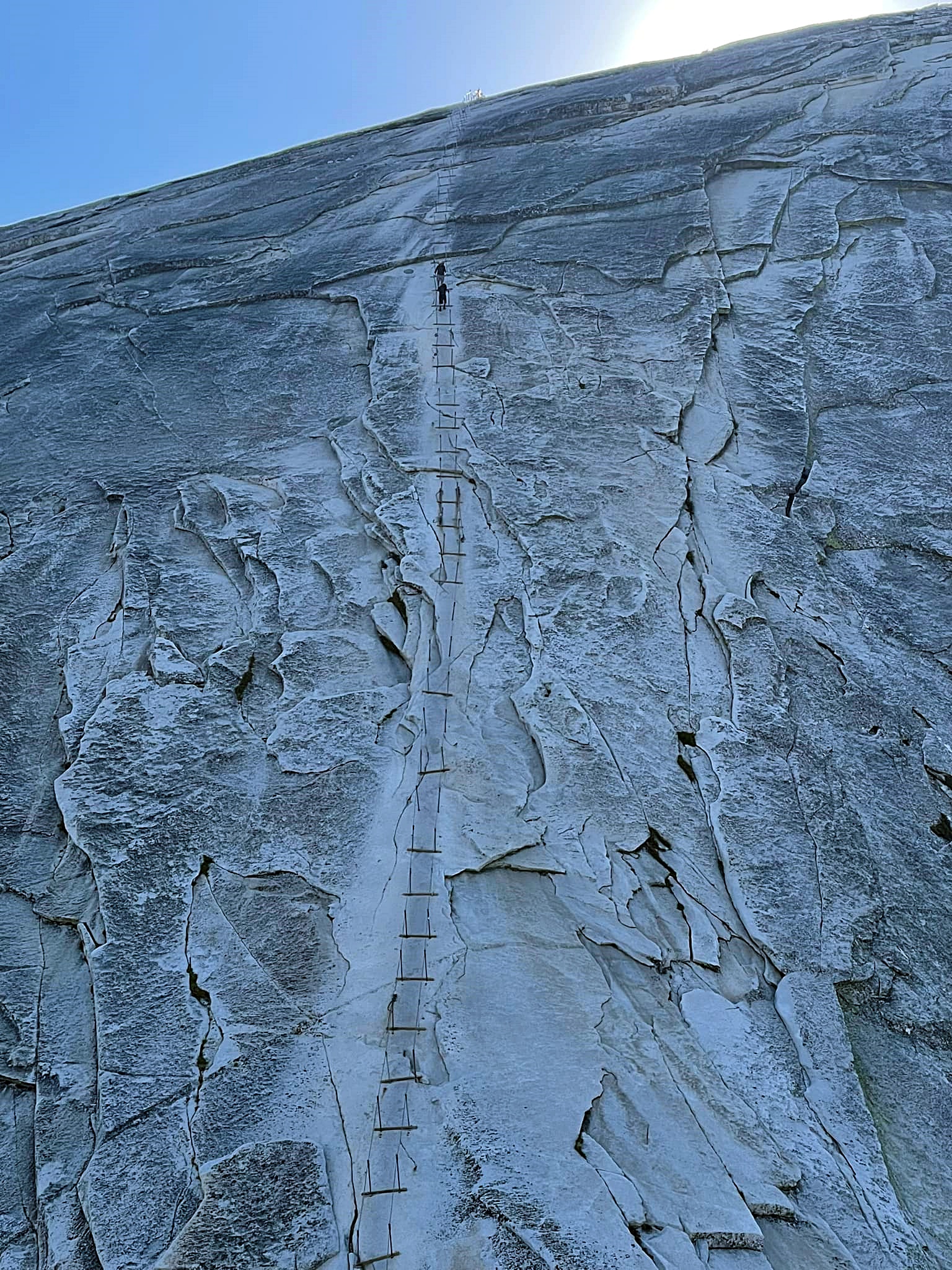
Over several hours Ralph climbed steep rocks through the mist created by two successive waterfalls and the steep and scary climb up the bare “arm” of Half Dome to its “shoulder,” with a sheer drop of thousands of feet slightly beyond one side of the trail.

Wearily and with great effort, Ralph slowly approached the level ground at the shoulder and saw the great, bald granite head of Half Dome rising impossibly, with a line of climbers like black ants crawling up the almost vertical rise. Hungry, thirsty, trembling with fatigue, worried about the walk back down in time before sunset, Ralph was quite discouraged, feeling he could go no further. He saw a ledge suitable for sitting, and sat, overlooking Yosemite Valley and lesser peaks.

After a few minutes of repose, he fumbled for his water and food, purposefully ignoring the path up Half Dome behind him, allowing his attention to dwell on the sight in front of him.

He slowly ate and drank, gradually becoming less self-conscious. He had let go of his desire to go further and felt free to rest and allow time to pass without worry. He knew he could get back in time from this point, even while resting as much as an hour or more.

Ralph’s sense of time ceased. He was gradually less conscious of today’s goal, of Half Dome’s peak and of the line of people ascending and descending it, now out of his view.

He entered a zone of consciousness with no name, as his body adjusted to the elevation and its recent exertions. He was at complete rest. He had no goals, no desires—he was just being on this ledge and seeming to merge with all that he saw before him.

An unknown and un-measurable period of time elapsed before Ralph became conscious, once again, of the muted noise of the people behind him and their exertions up and down the head of Half Dome.

As he turned and watched the people grapple with the heavy guidelines of rope secured to metal stanchions set deep in the granite of Half Dome’s head, he found himself rising, putting stuff back into and shouldering his pack, grabbing his stick and walking toward the line of climbers. He felt no desire, just a sureness that he would do this …

And he did!

The stanchions and ropes toward the dome

A List for E. George Smith

“Hey mister, ya’ talkin’ to the squirrels?”

Having had children, and now with grandchildren, E. George Smith is no stranger to interruptions which crash against his thoughts, but this intrusion jolts him. He, ungracefully and with some neck pain, swivels his head leftward to discover the source of these words.

He sees a child, a boy in dirty clothes, his dark skin revealing the lighter-colored dust on him, body and limbs moving in loose concert, on the grass near where George sits on a bench. Did I speak aloud?

“What’s a list?”

Yes, I must have spoken aloud. George watches the boy shoving a stick in and around a hole in the grass.

“Yes. A list,” he says to the boy and, as he likes to give straight answers to straight questions, he adds, “a list is writing on a piece of paper of all the things one should do.”

There, a straight answer a boy can understand.

“Who says you have to do ‘em?” the boy responds, while shoving gravel from the nearby path into the hole, his hands and limbs raising a cloud of dust that seem like the boy’s natural aura.

“Well, when I make my list, it is I, me, who says I have to do ‘em.”

After a few moments the boy pauses in his work. “I have a list but it’s too big to write and anyway I don’t write real good yet.”

Without preparing his words in advance (which is his usual way) George says “I used to write my list but then I could remember everything on it well enough, and anyway I don’t have a list anymore. No.”

“No” is a word George has avoided using in his life and, that he has now used it jolts him.

Then it is as if a dam has burst inside of George. Several great drops of water form and slowly fall from his eyes as he inclines his head forward and downward toward the gravel path. His head is directed somewhat away from the boy who lies prone on the grass at the edge of the path near where George sits on the wooden bench.

George’s body doesn’t move. Both he and the boy consider this surprising event while more tears fall heavily from George’s eyes. He visualizes a sheet of yellow notepaper bearing the word “list,” slowly dissolving in his mental image.

This is an extraordinary event for E. George Smith, both in meeting the boy and in weeping, even for a precious lost list. He could not have anticipated such an occurrence as he begins this first day of his retirement.

George Smith prefers his middle name to that of his first given name, Ebenezer, the “stone of help” in the Old Testament book of Samuel.

George lives austerely compared to his friends and associates. This is not to say he isn’t comfortable. He is wealthy beyond need by virtue of his ancestral inheritance which he has prudently and profitably husbanded, and which he has augmented through his own labor.

George and his wife Marilyn have fewer objects of the type that others in their San Francisco enclave have in the public areas of their homes. Marilyn happily subordinates herself to George’s taste for decorating their large, two-story apartment in Seacliff, so she can think about and do other things. George does not like clutter.

George is a rather large fellow, standing at no less than six feet with excellent posture, with firm, stout, arms, legs, and middle. He likes to be able to move his body and extremities around the apartment without worrying about knocking things around. He likes space.

But there are certain things he treasures and makes room for in his private areas. These are from his family’s past. George is the great-great grandson of Luke Smith (1826-1900) who emigrated to California from upstate New York in 1851 to set up a business serving the Gold Rush— hardware and machinery and, later, clothing. Success in these businesses eventually led the family to real estate and banking. So, George has placed, where Marilyn will least likely have to encounter them, several pieces: a gold pan, a rusty section of plume from a placer mine, the handle of a windlass from a mine shaft, and several more. On George’s home office wall hangs a faded and valueless stock certificate for shares in “The Lucille Gold Mining Company Limited” of Amador County, California, named after George’s great-aunt.

These all remind George of his family’s humble, hard-working and sometimes precarious origins, reminders he welcomes to keep him in balance with the weight of his wealth and social position in San Francisco.

There is one thing, however, that George cannot resist placing obviously in a visitor’s field of vision upon entering the apartment: a very ugly painting of great-great-grandfather Luke Smith, in a French Empire style frame and illuminated by lamps at top and bottom. It’s the only cross that Marilyn has to bear for George, so she constantly reminds herself to count it as a blessing.

Now on this beautiful day in autumn, E. George Smith had begun his new life by preparing to take a walk in the park of his childhood.

George and Marilyn live north of the park, near the cliff overlooking the ocean side of the Golden Gate and its famous bridge. Seacliff is an area where mansions on small and carefully manicured grounds are sometimes squeezed between tall, immaculate apartment buildings. George, having been a very busy man in his employed life, has always preferred to live in an apartment to minimize his household responsibilities.

Marilyn is from the same solid group of San Franciscans whose ancestors came from the east during and shortly after the Gold Rush of the 1840s and ‘50s. Their children, and George’s children from a previous marriage, are adults, some with their own children. George and Marilyn have retained their large apartment so that all their descendants, and their friends, may comfortably visit them upon a whim.

So, here is George, his long years of schooling and employment having ended, starting the traditional golden years of his leisure, contemplation and enjoyment of the family he helped to create along his life’s way. Yes.

George has been, from his beginning, a positive sort of fellow. He developed the habit of saying “yes” often, to himself and sometimes out loud. It is one of his harmless, some say charming, peculiarities that have buoyed him through the difficulties a d challenges of life. He feels fortunate in that he has had to face fewer challenges than most people by virtue of his family’s social and economic position upon his birth. He often includes this when he counts his blessings, another of his harmless, even admirable, peculiarities.

Yet another of George’s peculiarities is his “list”. From his earliest student days George has maintained a list of things to do on a yellow eight by five notepad. The one remaining item on his list at the beginning of this day is to visit Golden Gate Park. He sees nothing beyond this, and purposefully so. He feels the park will somehow show him what to do next.

Throughout his life he has harked back to his boyhood and the wonderful family times, picnicking on the grass near the stands of lordly oaks, tall conifers, and the grand, gently drooping eucalyptus branches. He has memories, even has had dreams, of searching for tree cones and eucalyptus acorns, and other adventures in the thick underbrush at the borders of the rolling lawns and meadows.

Walking is George’s favorite exercise. He doesn’t like to carry things, especially not golf clubs and fishing equipment. He likes to be free to move in any direction. This allows him the feeling, seldom realized but nonetheless satisfying, of being on the verge of an adventure that has an unknown outcome, so unlike his workaday life.

Marilyn has heard stories from her friends about the problems they have had with their “retired” men, but she feels no concern for herself or George because he always has his list of things to do. She accepts George just as he appears to be— positive, solid man, methodical but not stuffy, loving and friendly to his family and others.

“Still plan to take that walk in the park, E.G.?” She pronounces it “eejee,” her pet name for him, one he has never cared much for but doesn’t complain about. After all, it is such a small thing and it pleases her.

“Yes, dear.”

“Well, dinner will be at around seven o’clock. It’s just us.”

“I’ll be here.”

Having this validated by George, Marilyn goes about planning events and corresponding with family and friends, her usual activities in their large apartment, while George prepares a light lunch for himself.

Upon cleaning up after his meal and dressing suitably, E. George Smith leaves his home in the early afternoon on the first Monday of his new life and walks briskly toward the tall, un-gated columns at Lake Street that signal the portal to his neighborhood.

He continues south on 25th avenue, crossing streets and avenues with names that George has always felt as childhood friends: California, Clement, Geary, then the alphabetical Anza, Balboa and Cabrillo, which on the south side of the park continue faithfully from Irving through Wawona.

George begins to feel quite light around the shoulders and bouncy in his step. My new life. I am prepared for the unexpected.

George reaches Fulton, the long avenue defining the north border of the Park. He strides with a rising sense of purpose across the avenue. What new things will I put on my list?

He feels immediately at home upon entering the park, the menthol odor of the eucalyptus trees welcoming him. He espies the tree’s familiar round-capped seed pods on the ground and stoops to pick one up. He breaks it open to expose the still unripe seeds to smell the essence of the tree even more fully.

He wanders until he reached a curving, gravel path that brings him

to a familiar clearing with benches arrayed along the border of the grass and gravel. He sits on a bench with the sun behind him, facing a great live oak. He rests for a while, feeling his heart racing a bit from the walk and from his still unrealized sense of purpose. As his body’s rhythms slows, thoughts begin to form. What am I to do with the rest of my life? This he silently addresses to the newly cut grass, standing at attention on the other side of the gravel path. As usual when he is uncertain about a next move, he recites his blessings, a long list.

Then George moves on to the next item on his perennial agenda: his list of things to do. He reminds himself that having reached the park he has just completed his list of things to do. I am list-less, he thinks, with a sense of self-mockery at the unintended pun.

So here I sit, in this pleasant familiar park, wondering what to do next.

“I have no list”, he says toward the squirrels scrambling in the great oak tree above the attentive grass across the gravel path from the wooden bench on which he sits, comfortably clothed.

George’s tears form and drop for an unknown time until he sucks in a volume of air sufficient to cause his body to straighten, perpendicular to the grass and the gravel path. The boy’s body and limbs are still as he watches George closely. Eventually George turns his head again to his left.

“What’s your name, young man?” asks George, consciously using a diversionary tactic to distract the boy and to compose himself.

“Harry. What’s yours?”

“Harry. Yes. A good strong, manly name,” George says to the boy. “My name is George.”

They both consider each other’s names for several moments.

George’s eyes no longer leak, and he is still sitting straight, but now he feels unusually peaceful and relaxed. Yes.

“Uh, are you OK George?” the boy asks in a manner that seems to George to contain an unexpected degree of sensitivity.

“Yes, Harry. I feel quite good, actually.”

George looks again at Harry. Except that he is seemingly bright and appears in good health, the boy looks like a ragamuffin. What an old word. The boy would not know the word. The word no longer exists. He speaks with a musical lilt. Perhaps his family is from south Asia, India?

“What’s on your list, Harry?”

This opens what appears to George as the boy’s floodgates, words tumbling forth in verbal pictures, non-sequiturs, neologisms and street slang. His small and wiry body rises up from the grass and dances in accompaniment to the recitation of his list. What George can grasp is that on Harry’s list are mostly action items: achievement in sport; doing anything with cars; finding strange animals and doing things collaboratively with them; traveling in space; exploring secret caves; jungles, mountains, rivers, boats…

So much in such a small person.

Harry finally stops, then drops to his former position on the grass while looking intently at George.

Having scrutinized Harry further during his recitation, George sees that the boy is actually well dressed, including expensive-looking sport shoes. But everything he wears seems recently to have been through a shredder. It is Harry’s accompanying cloud of dust, continually precipitating on him that initially impressed George as shabbiness.

“That is a very big and wonderful list, Harry. You will do great things in the world.”

Harry smiles. He, too, seems more relaxed now.

George smiles back at Harry. “Do you often come to this park?”

“Yeah. After school sometimes.”

“Do you live nearby?”

“I don’t know. Not so far. Near the thin part of the park. On Page Street.”

“Oh, you mean the Panhandle. That’s pretty far away. Does your mother know you are here?”

“Sometimes. I don’t know. She wasn’t home when I left. She helps people.”

“Do you mean she works, that she has a job?”

“I don’t know. She helps the neighbors. Then I get bored with my sisters and come here after school. Baba has the job.”

Hearing Harry say “Baba,” apparently for “father,” George asks, “Does your family come from India?”

“Yeah, but I was born here. My sisters were born there.”

“What kind of work does your baba do?”

“I don’t know. Tech-nickel something. He takes a train every morning.”

George infers this to mean Harry’s father is a technician or engineer working for a dot-com on the San Francisco Peninsula.

George begins to feel uncomfortable about the boy’s safety, being so far from his home, and feels certain his mother will worry.

“Uh, Harry, I was about to walk toward the Panhandle and wonder if you were going to go home soon. Perhaps we could walk together.”

Harry starts poking more vigorously at the hole while he thinks about this.

“Well, I’m gettin’ kinda hungry but mama will be mad. Maybe you could tell her we were talkin’?”

“Ok, Harry, since it’s the truth.”

And so, they both stand up and arrange themselves to be side by side, as they aim eastward toward the center of the city.

“You will have to lead the way, Harry, since you know the way back home better than I do.”

“OK,” says the boy and begins swiftly to traipse along the path, George just a few inches behind him.

What a strange pair we are. We come from different worlds and now we are connected. The park connected us.

Page Street runs parallel to and one block south of the Panhandle starting at the eastern edge of the park proper, so they head east and south as the many curved and interconnecting paths will allow.

George and Harry don’t talk much during their long walk. Occasionally Harry points out a bird or a squirrel to George who responds, “uh huh,” and both emit other sounds that come naturally to men engaged in common effort.

After around twenty minutes of walking, they are suddenly back in the city with its traffic and noise and clumps of moving people. Harry, seeming more eager to get home, picks up his pace, allowing George to stride vigorously behind him.

“Ariya! Where have you been? Come here you dirty, sneaky boy.”

Aha, enter mama.

They are in front of a well maintained, typical San Francisco Victorian-era house, subdivided, showing four entrances side by side above the front steps. Here is mama in bright Asian dress, angry as a hornet.

She is a plump woman of medium height, appearing around 40 years old. She has a prominent streak of gray in her long, dark hair, all pulled back and secured by a colorful band. The brown color of her face is brightened by the red of her cheeks, apparently rouged to some degree, but certainly in higher color due to her current emotions.

Harry backs into George, stuttering to mama, “I wa-wa-was in the park and we sta-started talkin’,” indicating George with a backward wave of his hand.

Anger, relief, suspicion, and curiosity all seem to mingle on Mama’s face as she focuses her gaze on George.

“I thought it wise to accompany Harry home,” says George to mama. “Harry! Is this what he told you? This is what his stupid friends call him, ‘Dirty Harry.’ His name is Ariya, an honorable name.”

“We had a rather nice conversation, but we thought it was time for, uh, Ari? to be home. And so, here he is. My name is George.”

Mama lapses now entirely into relief that her precious boy is home. “Look at how dirty he is. Ariya, thank the man and go in the house and clean yourself before we eat. Tell your sisters to help you.”

Harry turns toward George, abashedly saying “thank you George,” and goes quickly up the stairs and into the first door at the right of the house’s porch.

“And, uh, thank you Mr., uh, George, for watching out for him. You seem to be a good man.”

“I had nothing else to do. I live on the other side of the park and was taking a walk.”

“Are you out of work?” Mama asks directly and seemingly without judgment. Her English shows an educated background, and her eastern lilt does not interfere with George’s understanding of what she says.

George chuckles softly and says, “Yes, I don’t work, I have retired from work. I have nothing else to do until I find out what to do next. I am open for suggestions.” George surprises himself by being so bold and in feeling drawn toward this friendly question from Mama. She seems to care, just as an ordinary matter of course.

“Perhaps my husband has some ideas. He’ll be home in around thirty minutes.”

“Well, this is a very kind suggestion, but I feel you must want to be with your family for dinner.”

“This is true,” mama says, “but here, take my card and give us a call when you like.” She quickly pulls a business card from somewhere in her clothing and hands it to George.

Not knowing exactly what custom to follow in receiving the card, he decides to treat it with the greatest respect, as do the Japanese, just to be safe. He carefully reads the card to learn that he has been speaking with Sonali Bose, a childbirth educator and a “doula” for expecting couples.

“You are very kind Mrs. Bose. My name is George Smith. I live over near Seacliff. I used to be a businessman, but have now retired, as I said, and so I have no card to give you. I started my retirement today by walking through Golden Gate Park, just as I did as a boy. I have grown children, and some grandchildren near Ari’s age.”

Mrs. Bose is quite attentive to his words but before she can respond, George asks her “may I know what a doula is?”

“Oh, it’s a bit complicated to explain just standing here, but mostly it’s to attend a woman in childbirth, but not help directly to deliver the baby. It’s an old practice that has been revived in the U.S., but it’s just a matter of course that women help each other during childbirth in other countries. Look, my husband is a very clever man and is well connected in his scientific field. Please give us a call and we can talk about anything you like. I am really so grateful to you for bringing Ariya home safely. I have to attend a birth tomorrow or the next day, so maybe you could come for dinner a few days from now, if you like. Anand, my husband, loves to talk with people from different backgrounds. He is insatiable. It would be a relief to me to have you talk with him so I could attend to my things, I am so busy lately,” she said quickly, almost breathlessly.

George could see in the rapid speech of his mama and in the description of his “baba” where Ari got his energy and his interest in the world as Harry currently imagined it. I am having the adventure I hoped I might have, and so soon. And so unpredictable! I could never have put this on a list.

George responds warmly, “Mrs. Bose, you are a gracious person and I will not deprive myself of the chance to meet your husband and talk with you both. I promise to call.”

Mrs. Bose smiles at George, as he offers his hand both in greeting and goodbye.

“Today has been a wonderful day for me, thanks to your son. I look forward to more conversations with him, too. It’s a bit of a walk back to my home, so I will leave now.”

Mrs. Bose nods, squeezes George’s hand and says, “Ariya is a good boy, I just worry so much about how to keep him interested in things near home where I can know he is safe. And how to keep him clean! Well, I am babbling, and you need to go, and I need to make sure the girls are getting dinner ready. I do hope you will call us. Goodbye.”

She squeezes his hand one last time, turns and quickly walks toward her front door, giving George a brief glance and a friendly wave before she enters her apartment.

George turns slowly to begin his walk back home, dazed by all the new impressions and all the energy he has encountered from the Bose family seen and unseen.

As he walks toward the sun, now descending toward the Pacific Ocean beyond the western boundary of the park, George walks pensively toward home, now over two miles away.

So much new has happened in such a short time, he needs the long walk to process it, and thinking how to recount this day to Marilyn. And how to tell her he would be soon be at dinner with an immigrant family from

India? This is a new world for both of them.

George suddenly realizes two new things have happened: he no longer needs to concern himself with a list—life will show him what to do.

And, he has met some of San Francisco’s new pioneers.

Yes.

Unexpected

“But I’m not expecting anything,” Clark protested. The FedEx man thrust a pen and clipboard toward him with one hand; in his other hand was a large, fat envelope.

“Please sign here.”

Clark hesitated, not sure what to do.

“Please, mister, I’ve got a lot of packages to deliver and just so much time to do it. If you just sign I can leave and you can do anything you want with the package.”

Feeling off-balance, Clark semi-consciously scribbled on the paper attached to the proffered clipboard, but he didn’t reach for the envelope. The FedEx man looked at Clark sharply, and then laid the envelope against the step beside Clark’s feet.

“Thanks. Goodbye.” And the FedEx man loped off to his waiting truck, its motor idling, seeming to Clark to be impatiently waiting to make the next delivery.

Clark stood inertly in his open doorway, watching the truck zoom around the corner where the street curved toward the freeway onramp.

He finally looked down at the bulging envelope near his feet. His head began to flood with images and questions. He reviewed all his few remaining relatives, but couldn’t think of any who would send him anything.

This left official agencies or businesses. Did the IRS return his tax papers for correction?  Maybe it was misdirected to him? Was it for a neighbor? Clark just couldn’t get a clear idea.

Finally, Clark decided to examine the envelope to see if the writing on it would answer any of these questions. He stooped and grasped the envelope at the corner nearest to him with his left thumb and forefinger and began to lift it, but then quickly put his right hand under the package. He thought it might weigh two or three pounds. “There’s a lot of paper in this,” he said to himself.

He looked at the delivery document inside its plastic cover, pasted to the front of the envelope. It was hard to find the name of a sender without his glasses, but the sunlight was bright enough for him to discern most of the printing and writing. There—a name and an address in the city. The name seemed familiar: “Spaeth.” Where had he seen that name before?

Clark sighed, deciding this was enough evidence to warrant opening the envelope. He turned away from the open door, gave it the usual nudge with his shoulder to close it and shuffled over to the end of the couch nearest the window, through which the afternoon sun’s light and warmth flowed invitingly.

Clark had all his necessary small tools on the table next to this end of the couch: TV remote control, two sets of glasses—one for reading and one for TV viewing—stacks of magazines and newspapers, pens and pencils, magnifying glass, and scissors. He put on his reading glasses and grasped the scissor handles.

The envelope’s plastic binding gave way to the point of the scissors so easily that Clark wondered how the package could stay intact through its travels. Soon he had in hand a one-page cover letter and three file folders bound together with rubber bands. The letterhead was from the law firm of Charles G. Spaeth. “Yes,” he remembered to himself, “Charlie Spaeth, my lawyer from so many years ago. What could he want with me after all this time?”

As Clark read the letter he realized this was from someone else, not Charlie. It was about Charlie. He had died and all his legal papers were being distributed to his former clients. There was no successor attorney.

Clark put the letter on the couch to his left and slowly removed the rubber bands from around the envelopes. There were three. One was labeled “Minsky, Clark: Trust.” He put it on top of the letter,
remembering that his trust was very simple and hardly worth the expense of creating it.

The next one read “Minsky, Clark: California Franchise Tax Board vs Minsky.” Clark issued a small grunt of satisfaction: “one of the few battles I’ve won.” This folder joined the other on the couch.

His grasp on the final folder slackened as he read, “Minsky, Clark: Final Divorce Decree and Agreement.” Papers fell and spread across the floor at his feet as he momentarily held the emptied folder, his fingers burning. He then dropped it on the pile of papers it once held and, with great effort, forced his right foot to slowly push the pile toward the TV, as far from himself as possible without the seat of his pants losing its purchase on the couch.

The sun moved slowly across Clark as he remained sitting on the couch. Motes of dust, illuminated by the glancing sunlight, slowly settled as Clark sat. The sun’s warmth and light finally left the window.

Clark remained in the darkness, slumped at the end of the couch, wondering if he had enough energy to get up and prepare his solitary dinner, a routine of the decades since Martha left him for Kerwin, his younger brother.

Weird

I wrote this in 1958, before we all became trapped in the Matrix.

I suppose I’m glad you were able to fit me into your tight schedule, doctor.

No, don’t be offended, please. It’s just that I know I should feel grateful, but I seem to be devoid of all emotions.

No, not sad, just blank. I am curious to know what motivated me in coming to see you, though. It was a tossup between you and the pills.

Sleeping pills. Least painful way I could think of. Hate pain. No, not hate—that’s too emotional. Have a tendency to avoid pain is more like it. Sort of a negative tropism.

No, nothing in particular prompted the decision.

No, I have no problems—nothing real, anyway.

Well, if you want something specific, I guess paper could be one of the main reasons.

Yes, paper. My wallet’s full of it. So’s yours. File cabinet over there, the notes you’re taking. We’re all accounted for on paper. There must be a few hundred thousand sheets of paper that represent me. Birth certificate, school records, medical records, military service records, dental records, marriage license, divorce records, driver’s license, insurance papers, credit rating, job record—there most be more somewhere I don’t know about.

I’m all accounted for. I’ve been drained dry. I’m all on paper. If you want to find the real me, just search through a few hundred sheets of paper. But you know all about this. After all, you’re about twice my age.

No, I’m only twenty-five. I do look kind of withered, don’t I?

Sure I’m sure. Here’s my driver’s license. See? I have other proof too, if you want it.

You sure are taking a lot of notes, aren’t you? I have a feeling that you shouldn’t write so much, doctor. Gives me a kind of gnawing sensation. I don’t know how to describe it… Feeling thirsty… Say, doctor, please don’t write so fast… DOCTOR…

“Nurse, Anne, come in here. No, first call Doctor Brady, then come in.

“Look at this man—he’s all shriveled up. He just sat there and shriveled up and dropped dead. Weirdest thing I ever saw.

“Oh, hello Pete. Look at this guy. Weird, huh? Look at these notes I took. See what you think.

“Anne, call the coroner’s office will you?

“Pete, I’m going to write this up and present to the next regional meeting.”


Imaginary Hike…

…In the Coastal Range of Central California

The first few hundred yards are the easiest and quickest. Civilization soon gets behind and below me in my initial haste. I change to the regular and slower, upward marching that gets my heart, legs and lungs in a pleasing synchronicity.

I adjust my senses for possible sudden signs of wildlife as the unfamiliar trail narrows and the foliage thickens. I am not afraid of the coyotes, tarantulas, and bobcats, but a harmless lizard will make a sudden move that says: snake!

The only dangerous plants are the shiny red and green bushes of poison oak and the needle-tipped leaves of the yucca plant, both easily discerned.

I enter a cloud and its moisture brings welcome coolness to my face and arms.

The continuous, regular rhythm of my lungs’ halations helps me purge the feelings and thoughts associated with other humans and their works.

There is no trail to guide me further. I find a deer track.

Umunhum-03The foliage is watered by Pacific fogs and low clouds at this elevation.  Patterns of moisture flow through the undulating and twisting canyons, and through the convoluted layers of sedimentary rock below the surface.

Trees, bushes, grasses, mosses, lichen.

I don’t want to twist an ankle or break a bone by slipping into a hidden hole or crevasse.  No one knows where I am.

The delicious danger of this part of the hike makes my heart beat with more urgency than called for by the exertion of the climb.  My senses are at their peak alertness and I feel fully alive and vibrant.  I am not fearful, nor am I careless. I am positive in every movement; I neither hurry nor plod.  I observe everything around me directly, without being conscious of my observing.

This steeper climb taxes my legs and lungs, but the adrenaline generated by the adventure helps me easily overcome the burden.

Without time and almost without space, except for the flow of greens and browns past my eyes, I march upward.

I enter a different vegetation zone. Things are deeper green, and denser. Smells are damper, more pungent.  I step over trickles of water seeping from beneath the layers of fallen leaves and dead tree limbs.

I break through the top of the cloud.  The foliage is too high and thick to permit but small bursts of direct sunlight.  The dryer air has a lightness that stimulates me to quicken the pace.

I suddenly emerge into a clearing, the sun slanting from the right.  I stop, back up slightly to scan the open area from the shade, and allow my breathing and heart to resume slower rhythms.

I’ve worked up a sweat.

A large rock formation in the treeless area ahead offers time in the sunlight.

The sounds of the birds envelope me.  They have become untouched friends over the years.   I am gladdened and relaxed by their chattering, chirping, clicking and warbling.  Even the raucous jays are part of this pleasant symphony.

I see the ridges of the nearby mountains for tens of miles.

I doze, aware but unfocused.  No questions, no concerns.

Time no longer exists.  I am where I am.

I have joined with the forest and its mother, the mountain.

I am home.